
1. Non-Terrestrial Networks (NTN) in a nutshell
Non-Terrestrial Networks (NTN) systems exploit spaceborne and airborne platforms organised in an interconnected infrastructure to provide wireless services on the surface of the Earth.

The spaceborne component is located in space and operates in different types of orbit, among which Geostationary (GEO), Medium Earth Orbit (MEO), High Elliptical Orbit (HEO), and Low Earth Orbit (LEO), as shown in the figure above. The airborne component operates within the atmosphere and includes High Altitude Platform Stations (HAPS), quasi-stationary platforms typically flying in the stratosphere at around 20 km, as well as Unmanned Aerial Systems (UAS) and Air-to-Ground (ATG) systems. Both components may host transparent (bent-pipe) or regenerative payloads, the latter embarking part or all of the network functions on-board. NTN systems operate in frequency bands allocated to Broadcasting, Fixed or Mobile Satellite services in lower frequency bands (below 3 GHz, such as VHF, UHF, L and S band) or in higher frequency bands (above 3 GHz, such as C, X, Ku, Ka, Q and V bands), as well as, for HAPS-based IMT deployments, in terrestrial mobile bands.
NTN systems can address a wide range of services, including broadcast, broadband, narrowband. and Internet of Things (IoT), including direct connectivity to unmodified handheld devices, serving fixed, portable, and mobile terminals over global, regional, or localised coverage. Some NTN systems provide service coverage all over the Earth, including the North and South poles, while airborne platforms can be deployed on demand to reinforce capacity or restore connectivity where and when it is needed, such as in Public Protection and Disaster Relief (PPDR) scenarios.
They are well recognised to provide a resilient and ubiquitous service and to be particularly cost effective for “one to many” (broadcast) and “many to one” (data collection) services, which is ideal to complement other telecommunication technologies to meet the “everything, everywhere, all the time” Internet paradigm. Increasingly, NTN are no longer a standalone segment but an integral part of a three-dimensional, multi-layered network in which terrestrial, airborne, and spaceborne resources are jointly designed, orchestrated and standardised, an approach embodied by the 3GPP NTN specifications from Release 17 onwards and a pivotal element of the 6G communication infrastructure.
2. Overall objectives
The mission of the NTN Working Group is to foster the development of NTN, consisting of Satellite Communications and airborne systems, and define their strategic positioning in the 2025-2035 timeframe in support of global service continuity, ubiquity, resiliency, and multi-service solutions.
3. NTN WG organisation
The structure of the WG is reported in the figure below and it consists in three Task Forces (TFs):
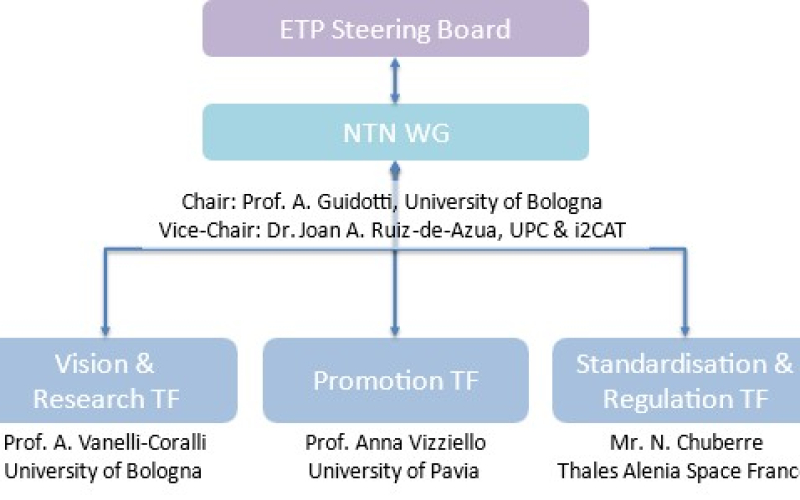
Vision & Research Task Force, aiming at:
- Defining the vision and priorities for NTN R&I topics, including TN-NTN convergence within 6G and beyond
- Communicating NTN-related R&D inputs to EU and National bodies (g., SNS JU, ESA)
- Analysing EC policies on NTN R&D to develop and convey the sector position towards EU stakeholders
Standardisation & Regulation Task Force, aiming at:
- Raising awareness about general plans of relevant standardization and regulatory bodies (g., ITU-R, 3GPP, IETF, IEEE, ETSI/TC-SES, etc.) to the NTN WG research community
- Fostering research collaborations on specific technical contributions related to NTT
Promotion Task Force, aiming at:
- Promoting the need for financial support for European NTN industry’s research and innovation activities towards the European institutions
- Promoting the NTN WG activities in relevant international fora and events, coordinating efforts among the WG members
NTN WG key contacts
WG chairman: Alessandro Guidotti, University of Bologna: a.guidotti@unibo.it
WG Vice-Chair: Joan A. Ruiz-de-Azua, UPC & i2CAT Foundation: joan.ruizdeazua@i2cat.net
Vision & Research Task force leader: Alessandro Vanelli-Coralli, University of Bologna: alessandro.vanelli@unibo.it
Promotion Task Force leader: Anna Vizziello, University of Pavia, anna.vizziello@unipv.it
Standardization & Regulation Task Force leader: Nicolas Chuberre, Thales Alenia Space: Nicolas.chuberre@thalesaleniaspace.com